
Agriculture & Land Use
Soil health and carbon sequestration solutions for farms, ranches, and land management.
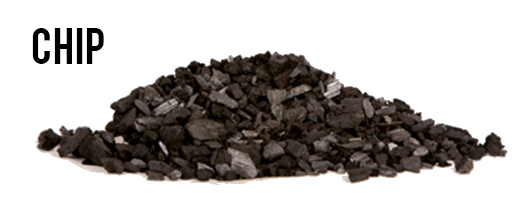
Chip Biochar
Application Rate
1-2 lbs per sq ft of bedding
Expected Results
60% ammonia reduction, improved bird health, $6,400 net benefit per house annually
Why This Grade?
Coarse particles provide maximum airflow and ammonia capture in bedding systems
The coarse Chip grade (1" – 3 mm) provides optimal airflow while capturing ammonia and moisture. Field trials at Shenandoah Valley show 60% ammonia reduction, improved bird health metrics, and enhanced litter value as fertilizer. After use, biochar-enriched litter commands premium pricing for crop application.
Case Study
Shenandoah Valley Cooperative: 60% ammonia reduction, $6,400 annual savings per house
Application: Spread 1-2 lbs Chip biochar per sq ft before placing birds; reuse biochar-enriched litter as soil amendment
Oklahoma Fit
Poultry operations across Oklahoma, particularly in eastern counties
Pricing Context
At $1000/ton, cost is $0.50/sq ft. ROI: 4-6 months through reduced mortality, better feed conversion, and premium litter sales.
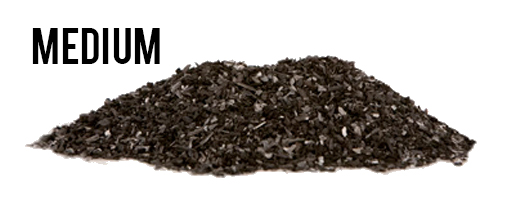
Medium (broadcast) or Powder/Small (banded)
Application Rate
Medium: 2-5 t/ac broadcast; Powder/Small: 1-3 t/ac banded in rows
Expected Results
10-20% yield increase, 10-25% fertilizer savings, 10-20% irrigation reduction
Why This Grade?
Medium for field-scale blending; Powder/Small for precision banding near seed rows to increase cation-exchange capacity
Medium biochar (3 mm – 26 mesh) is ideal for broadcast application and incorporation across fields. For banded application near seed rows, use Powder or Small grades for better distribution. The ~400 m²/g surface area retains nutrients and water, reducing fertilizer leaching and irrigation needs. Benefits accumulate over multiple seasons as biochar persists in soil. Rates assume ~400 m²/g biochar; lower-grade chars may require 2-3× more.
Application: Broadcast Medium biochar at 2-5 t/ac and incorporate 4-6 inches deep, or band Powder/Small at 1-3 t/ac in seed rows
Oklahoma Fit
Dryland wheat and sorghum in northwest OK and sandy soils along the Red River
Pricing Context
At $1000/ton: $2000-5000/ac initial investment. Payback in 1-2 crop cycles through input savings and yield gain.
Medium Biochar
Application Rate
1-3 t/ac baseline; 3-8 t/ac for sodic spots (with gypsum 2 t/ac)
Expected Results
10-25% forage growth, better drought resilience, reduced sodicity in problem areas
Why This Grade?
Medium grade improves soil structure, infiltration, and forage nutrient density; survives grazing and weathering
Topdress Medium biochar at 1-3 t/ac and drag to incorporate into top 2 inches. For sodic spots with high sodium, apply 3-8 t/ac Medium biochar with gypsum to improve infiltration and reduce Na⁺ toxicity. The alkalinity (pH 8.5-9.0) and pore structure help restore soil function. It acts as a permanent carbon reservoir for root zones. Benefits include better forage establishment, improved drought tolerance, and enhanced nutrient cycling.
Application: Topdress Medium biochar and drag; for sodic areas, blend with gypsum before application
Oklahoma Fit
Ranches in western and panhandle counties seeking lower hay costs and rangeland recovery
Pricing Context
At $1000/ton: $1000-3000/ac for baseline treatment, $3000-8000/ac for sodic restoration. ROI: 1-3 seasons depending on rainfall and hay prices.
Medium or Small Biochar
Application Rate
5-20% by weight in compost piles (optimal 10-20%)
Expected Results
CH₄↓ ~54%, N₂O↓ ~50%, NH₃↓ ~36% (2025 meta-analysis); odor suppression, higher N retention, +$5-20/yd³ finished compost value
Why This Grade?
Granular Medium grade provides aeration, odor control, and microbial habitat; Small grade for aerated static piles
Add Medium biochar at 5-20% w/w (optimal 10-20%) to poultry compost, dairy manure, or municipal organics. Recent meta-analysis (2025) shows optimal performance at 10-20% w/w with CH₄↓ ~54%, N₂O↓ ~50%, NH₃↓ ~36%. The porous structure provides aeration channels and captures nutrients that would otherwise volatilize. Note: acidic or high-EC systems may underperform. Finished compost has higher nutrient density and water-holding capacity. For aerated static piles, Small grade can be used for better distribution and even airflow.
Application: Mix Medium biochar at 5-20% w/w (optimal 10-20%) during pile construction; turn as normal; finished compost retains biochar benefits
Oklahoma Fit
Poultry operations and municipal compost facilities (Tulsa / OKC)
Pricing Context
At $1000/ton, biochar adds $50-100 per ton of finished compost but increases compost value and reduces odor complaints. ROI: 1-2 compost cycles.

Medium or Small Biochar
Application Rate
5-20% by volume in engineered soil
Expected Results
40% higher infiltration, 50% irrigation savings, 40-80% nutrient runoff reduction
Why This Grade?
Medium or Small enhances water infiltration and nutrient holding; Small grade if irrigation injection or drip systems are present
Incorporate Medium or Small biochar at 5-20% v/v in engineered soil mixes for urban plantings, rain gardens, and bioswales. The porous structure improves water infiltration, reduces nutrient runoff to storm drains, and supports healthier root systems. Use Small grade if irrigation injection or drip systems are present to avoid clogging. Benefits include reduced water bills, lower fertilizer needs, and improved stormwater management.
Application: Blend Medium/Small biochar at 5-20% v/v into engineered soil before installation; maintain standard irrigation practices
Oklahoma Fit
Urban landscapes and stormwater bioswales (OKC, Norman, Edmond)
Pricing Context
At $1000/ton, biochar adds $50-200/yd³ to soil cost. ROI: 6-18 months via water and plant replacement savings.
Powder/Small (hydroseed) or Medium (topdress)
Application Rate
Hydroseed: 5-15% mix; Topdress: 2-5 t/ac (erosion) or 5-20 t/ac (mine spoils)
Expected Results
30-60% runoff reduction, 2-4× faster vegetation cover
Why This Grade?
Powder/Small for hydroseed slurry; Medium for topdress to reduce surface runoff and improve seed germination
For hydroseed applications, blend Powder or Small biochar at 5-15% into slurry mix. For topdress on slopes, apply Medium biochar at 2-5 t/ac for erosion control or 5-20 t/ac for mine spoils with compost. The porous structure holds moisture near seeds, reduces runoff velocity, and provides microbial habitat for faster establishment. Particularly effective on compacted or low-organic soils.
Application: Mix Powder/Small into hydroseed slurry, or topdress Medium biochar on slopes with compost before seeding
Oklahoma Fit
Pipeline and highway corridors under ODOT contracts
Pricing Context
At $1000/ton, biochar adds $100-250/ac for erosion control, $2500-10,000/ac for mine spoils. ROI: Within first project season.
Medium Biochar
Application Rate
5-20 t/ac blended with compost or topsoil
Expected Results
80-95% vegetation cover one year sooner, 30-50% cost savings vs. imported topsoil
Why This Grade?
Medium biochar rebuilds soil structure and immobilizes residual metals, supporting vegetation on spoils and compact fill
Apply Medium biochar at 5-20 t/ac blended with compost or topsoil to mine spoils, construction fill, or degraded sites. The porous structure improves water infiltration, provides microbial habitat, and can immobilize some residual metals. Biochar-amended sites achieve 80-95% vegetation cover one year sooner than unamended controls, reducing erosion liability and reclamation costs. Cost-effective alternative to importing topsoil.
Application: Blend Medium biochar with compost or topsoil at 5-20 t/ac; spread and seed according to site plan
Oklahoma Fit
Abandoned mine lands in southeast OK and large-site construction projects
Pricing Context
At $1000/ton, biochar costs $5000-20,000/ac but saves 30-50% vs. topsoil import and accelerates site closure. ROI: 1-2 years.
Any grade (depends on application method)
Application Rate
2-10 t/ac depending on credit program requirements
Expected Results
1 t biochar ≈ 3-3.6 t CO₂e stored; credit value $120-300/t CO₂e
Why This Grade?
High-temp biochar (H/C < 0.4) provides durable carbon storage for verified credit programs
InfiniteEco's high-temperature biochar (H/C < 0.4) meets permanence criteria for durable carbon removal credits. Each ton of biochar sequesters ~3-3.6 tons of CO₂ equivalent for 1000+ years. Document feedstock-to-char yields and end-use application for credit verification (MRV: Measurement, Reporting, Verification). Biochar in soil applications earns removal credits; activated-media reactivation earns cost savings but not additional removal credits unless net carbon is added.
Application: Apply biochar to soil at documented rates; maintain records for credit verification; work with carbon credit aggregators
Oklahoma Fit
Producers joining Climate-Smart Commodities and Puro.Earth aggregator projects
Pricing Context
At $1000/ton biochar + $120-300/t CO₂e credit revenue, net cost can be $100-400/ton depending on credit market.
Premium Biochar Advantage
InfiniteEco Biochar
Commodity Biochar
Use 50-66% less material with InfiniteEco engineered biochar due to higher surface area and optimized pore structure.
Ready to Explore Agricultural Applications?
Discover how biochar can improve your soil health, reduce input costs, and create measurable carbon storage.